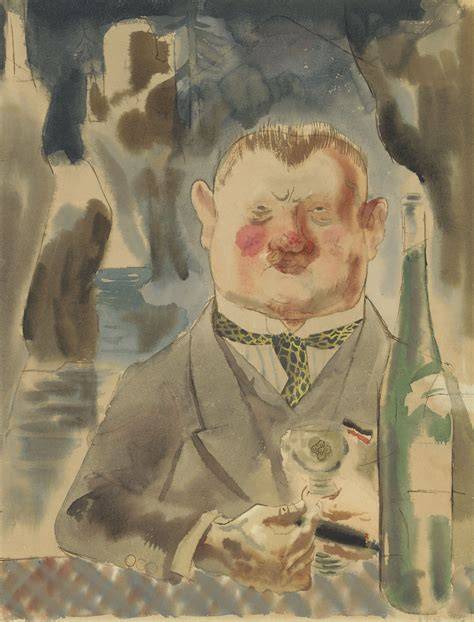
Leading artist of the New Objectivity movement, George Grosz produced drawings, prints and paintings that condemned political corruption and social injustice during the interwar period in Germany through a lens of sharp critical satire. Grosz synthesized caricatures and symbolic representations of recognizable political figures with the abstraction of Futurism and Cubism along with the aesthetics of popular illustration. As a whole, his oeuvre harshly lampoons the capitalist and militarist forces perpetuating the interwar global crisis, the failing bureaucratic systems of Weimar Germany, and the rising threat of nationalism he witnessed during those years.
Born in 1893, Grosz trained at the Dresden Academy of Fine Arts and the Berlin College of Arts and Crafts, studying under Robert Sterl and Osmar Schindler. He became a leading member of the Berlin Dada group, and collaborated with colleagues including John Heartfield. Both artists had changed their given names - Georg Groß and Helmut Herzfeld - to anglicized versions in protest of the growing German nationalism. During the interwar years, Grosz produced a series of important political drawings based on his time at a convalescent clinic following the First World War, which harshly condemned the military system and immoral doctors who forced unfit soldiers back into battle, or failed to treat survivors.
These were followed by a series of paintings, which mocked the German voters as automatons conned by propaganda and self-serving politicians, as well as the debauched antics of the upper and middle classes who ignored the rising rates of poverty. In January 1933, the same month Hitler became chancellor, Grosz immigrated to America, where he taught the Art Students League, and developed his own compositions further into abstraction. Considered one of the most important political artists of the 20th century, Grosz’s works are on view at major modern art institutions including the Museum of Modern Art, New York; the Thyssen Bornemisza Museum, Madrid; the Tate Modern, London; and many others.
Installation view from the exhibition George Grosz: Between Two Self-Portraits, 2022 The Professor, Faculty of Fine Art, Music and Design, UiB (KMD) Bergen. The collection of the Berlinische Galerie in Berlin holds a self-portrait by George Grosz painted in 1927, Selbstbildnis als Warner (Self-portrait as Warner). The artist depicted himself wearing thin, gold-framed, round spectacles, and a blue-grey smock from the twentieth century that would typically be worn by a teacher or scientist. Standing, facing the viewers, he points one finger into the sky in what is seemingly a sign of warning, as he stares out with a deep and worried gaze. He has something to tell to an audience. The work was produced at a particularly uncertain and hostile time. Painted four years after Adolf Hitler’s attempted coup d’état in 1923, it resonates as a tragic prediction when we consider the horrors perpetuated by the Nazi regime in the years that followed. Grosz’s political commitment is inseparable from the work. Indeed, this painting speaks volumes to the confidence that the painter had in art’s power to convey and deliver an idea, a message-and its inherent educational value.
Shown in the context of the Professor, a reproduction of this self-portrait features in a panel exhibition at the Faculty of Fine Art, Music and Design, UiB (KMD), together with folios of political prints published between the 1920s and 1930s in various left-wing magazines and broadsheets, including the lithographs portfolios Im Schatten (In the Shadows, 1921), Die Räuber (The Robbers, 1922), and Hintergrund (Background, 1928). In this collage, which is tinged with self-mockery, the artist represents himself as a drunken clown dressed as a showgirl dancing in variety shows. He holds a bottle of Four Roses Bourbon, and New York’s skyline at night shimmers in the background. Made long after Berlin’s dark years in the interwar period, it was produced within the prosperous context of the United States in the 1950s, building its mythical American dream, where Grosz lived and taught after being forced into exile in 1933. Between the two works-the sobriety and seriousness of the 1927 self-portrait and the exuberant decadence of the second one, made thirty years later-we can see the contradictions faced by an artist who never ceased casting a sharp and critical eye on himself or the society that surrounded him.
George Grosz was known for making caustic caricatures underpinned by a social commentary of life in Berlin. His drawings and paintings are distinctive for their expressive use of line. After moving to Berlin, his collections of drawings repeatedly depicted the ravages of war, including disfigured veterans. He also attacked what he saw as Germany’s pervasive moral and social corruption, depicting sordid bourgeois decadence and the disparities between rich and poor, as well as acts of war profiteering during the Nazis’ ascendancy. His 1927 painting Selbstbildnis als Warner (Self-Portrait as Warner) was a reaction to the continuing rise of fascism, warning others with a raised index finger to take heed of these socio-political changes, though he later said: “I realised that people just didn’t listen to what I had to say with my work. As the Nazis took power in 1933, he moved to the United States, having already taught at the Art Students League, New York, and became an American citizen. His style subsequently shifted into painting still-life compositions, and landscapes. Grosz returned to Berlin in 1958 and died only a few months later, falling down a flight of stairs after a night of drinking.
“Daum” is an anagram for “Maud”, as George Grosz (1893-1959) called his girlfriend and future wife, Eva Peter. The excessively long, tongue-in-cheek title of this work refers to the wedding of this evidently ill-matched couple. Scantily clad, Daum stands next to George, an automaton pieced together from body and machine parts. Vivacious sensuality versus cool, robotic functionality - the antithesis is reinforced by the use of different techniques: the soft, rounded forms of the young woman are depicted quite traditionally in ink and watercolour. "Daum" marries her pedantic automaton "George" in May 1920, John Heartfield is very glad of it.
Ukončeno ve středu 18. 6. 2025, 07:48:25 Doprava Doporučená zásilka 140 Kč Kurýr / Doručení na adresu obyčejné 140 Kč Doba dodání 7-10 dní George Grosz Stav zboží delší doba používání, funkční produkt
George Grosz (1893-1959) byl německoamerický malíř, grafik a karikaturista. Jeho styl postupně ovlivnil expresionismus, futurismus a dadaismus, stal se členem uskupení Nová věcnost. Proslul kritikou společnosti Výmarské republiky. Vydání: SNKLU, Praha 1965. Humor a kresby, sv. 2. Měkká vazba, 140 stran, 112 reprodukcí, rozměry: 16 x 18 cm. Stav: Velmi dobrý stav, obálka je zašpiněná. Vyřazený knihovní exemplář - na příděl je nálepka knihovny, na tiutlním listu razítko "vyřazeno".
George Grosz in Amerika, 1932-1959, Ph.D. diss., Universität Karlsruhe, Frankfurt, 2007, p. 203 (illustrated, pl. The Art Institute of Chicago, George Grosz, A Survey of His Art from 1918 to 1938, December 1938-January 1939, no. 23. New York, Associated American Artists Galleries, George Grosz, February 1943, no. 5 (titled My Face in the Bathroom Mirror). Huntington, New York, Heckscher Museum, George Grosz, Works in Oil, July-September 1977, p. 26, no. 32 (illustrated, p. 18). Washington, D.C., The Hirshhorn Museum and Sculpture Garden, Smithsonian Institution, George Grosz, September 1978-January 1979, no. 15. Kamakura, Museum of Modern Art; Itami City Museum of Art and Utsunomiya, Tochigi Prefectural Museum of Fine Arts, George Grosz, Berlin-New York, April-September 2000, p. 52, no. I-24 (illustrated). Akademie de France à Rome, Villa Medici, George Grosz, Berlin-New York, May-July 2007, p. 214, no. 302 (illustrated in color).